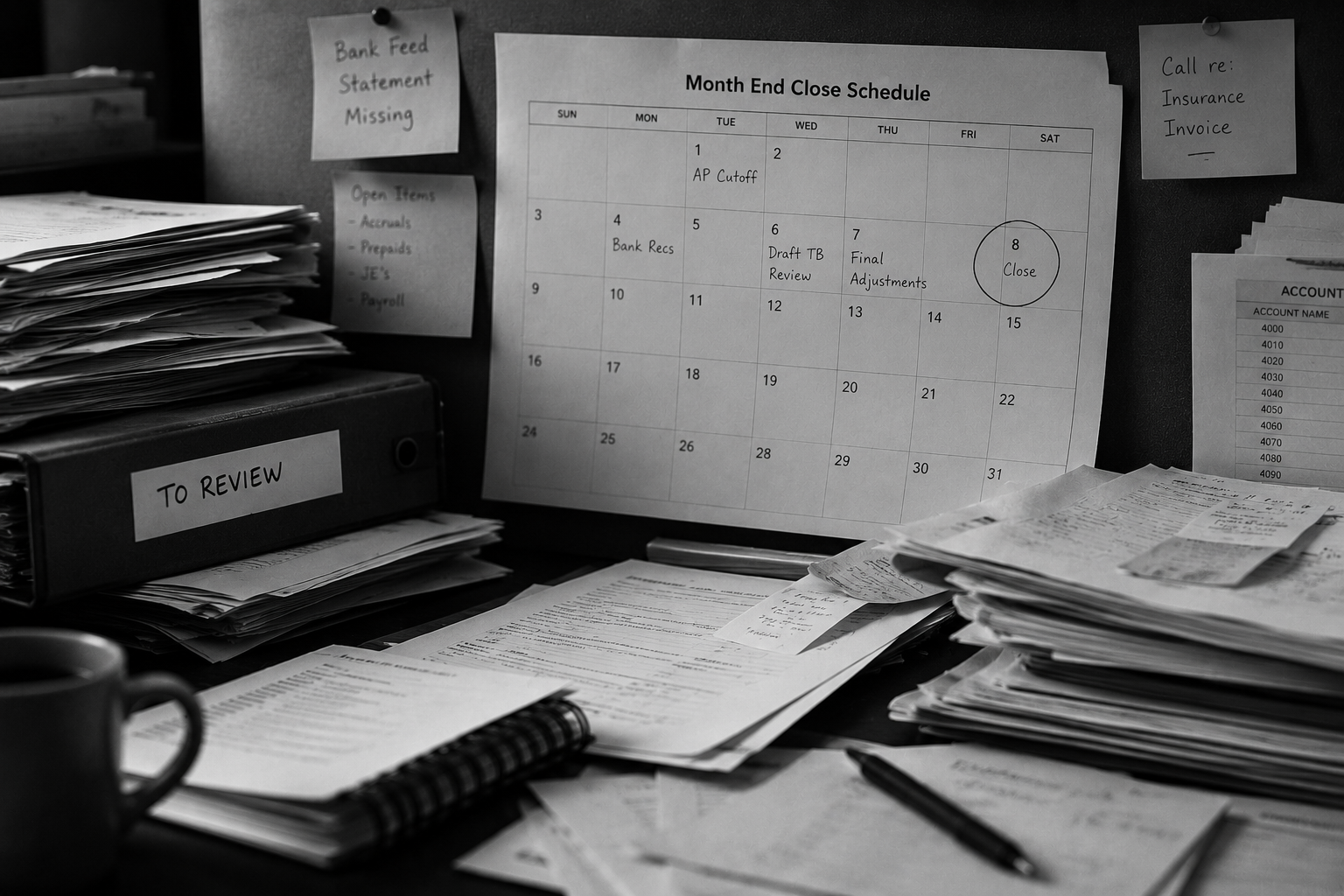
Most owner-managed businesses close their books three to six weeks after month-end. By the time the numbers land, the decisions they would have informed have already been made — on instinct, on memory, or not at all.
The lag isn't laziness. It's structural. And it comes from the same three places, almost every time.
1. The close depends on one person
The most common pattern: a bookkeeper who knows the accounts intimately, works mostly alone, and handles everything from AP entry to reconciliation to the final trial balance. When they're sick, distracted, or just swamped, the close slips. The business doesn't know it's slipping until the owner asks and gets a vague answer.
A close that depends on a single person isn't a process — it's a risk. The fix isn't more urgency. It's segregating the work so that no single step is a single point of failure.
In practice, this means treating AP entry, bank reconciliation, and final review as three distinct stages with explicit handoffs — even if the same person completes all three in a small business. The discipline comes from naming the steps and setting deadlines for each, not from hiring more staff. When the steps are defined, a gap is visible. When it's all one amorphous task, a delay anywhere collapses everything.
2. Source documents arrive late
Reconciliation can't happen until every transaction is explained. Explained transactions need supporting documents — vendor invoices, receipts, bank statements, credit card feeds. When those arrive late (or don't arrive at all), the close waits.
The discipline required here is upstream of the bookkeeper: expense policies, receipt habits, AP approval cadence. Most small businesses treat this as an administrative nuisance. The ones that close on time treat it as a system.
What that system usually looks like: a hard cut-off date (typically the 2nd of the following month) after which no prior-month expenses are accepted without a reopen request; automated bank and card feeds that eliminate the "waiting for the statement" problem; and a named approver for each expense category, so the bookkeeper isn't chasing five people individually. None of this requires expensive software. It requires a decision that the cut-off is real.
3. There's no hard deadline — or no one owns it
"We close around the 15th" is not a deadline. It's a vibe. Without a hard date and a named owner, the close migrates to whenever everything is convenient. And convenient is never.
The businesses that close by the 8th all have the same thing in common: someone has made the 8th a non-negotiable, and every upstream process — AP cut-off, bank feed, payroll journal — is reverse-engineered to support it. The close date is set first, then the supporting schedule is built backwards from it. AP cut-off is the 1st. Bank recs are done by the 4th. The draft trial balance is reviewed on the 6th. Final adjustments posted by end of day on the 7th.
That kind of close calendar sounds formal for a ten-person business. But without it, the same ten-person business will spend the first three weeks of every month in a loose negotiation with itself about when the numbers will be ready.
What the fix actually requires
The three problems above are related. A single-person dependency creates a fragile process. A fragile process can't enforce document cut-offs. Without enforced cut-offs, there's no basis for a hard deadline. The whole system either holds together or it doesn't.
Fixing it means building the process before optimizing the people. Not new software. Not a new hire. A written close schedule, a document policy with teeth, and an owner who has decided that month-end numbers arriving on time are worth more than the flexibility of a loose system.
The cost of a late close isn't just inconvenience. It's the board meeting where you're reading June numbers in August. It's the cash decision made without a current picture. It's the audit that finds surprises no one saw coming because no one was looking at current data.
Fixing it requires treating the close as a production process, not an accounting task. That's a different conversation — but it's one worth having before month five of a late close becomes month twenty.
If your books are consistently late, a 30-minute call usually finds the specific bottleneck quickly. We're happy to tell you what's wrong even if you don't end up working with us.